





MD14: Investigating the influence of chronic inflammatory bowel disease on the antibacterial immune response in the lung
David BeckerMD Student
Dunja BruderProject Leader
|
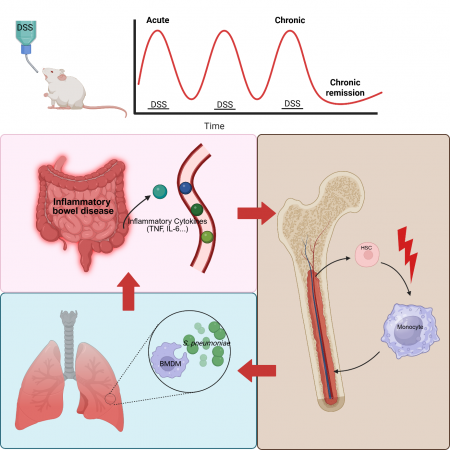
Ulcerative colitis (UC), one of the two major forms of inflammatory bowel disease (IBD), is a chronic disease characterized by continuous inflammation of the mucosal tissue in the colon. UC patients have an increased susceptibility to lung infections, suggesting local gut inflammation as an underlying cause for an altered systemic immunological response. To model UC in animal models, mice are repeatedly treated with dextran sodium sulfate (DSS) to induce chronic phases of intestinal inflammation, as well as their respective remission periods. UC is considered a systemic disease and we hypothesize that intestinal inflammation via inflammatory mediators released into the bloodstream modulates haematopoiesis, thereby impacting the functionality of immune cells during their generation in the bone marrow. This could potentially increase vulnerability to lung infections. To investigate this, our project first utilizes in vitro studies to evaluate the functional consequences of haematopoietic imprinting. By generating bone marrow-derived macrophages (BMDMs) from mice with chronic colitis, we assess their antibacterial function through flow cytometry-based phagocytosis assays. Furthermore, we quantify the maximum killing capacity of these macrophages by measuring the generation of reactive oxygen species (ROS), while evaluating cell viability and programmed cell death via Annexin-V and Propidium Iodide apoptosis assays. Finally, these findings are translated to an in vivo model, where mice in the remission phase of DSS-induced chronic colitis are challenged with the respiratory pathogen S. pneumoniae. We will then conduct a comprehensive evaluation of the immune cellular dynamics within the gut-bone marrow-lung axis, alongside an assessment of the mobilization capacity of immune cells from the bone marrow. This approach will allow us to determine how a chronic gut inflammation functionally alters the local pulmonary immune system´s capacity to mount an effective defence against a bacterial pathogen, thereby revealing the mechanisms behind the reported increased susceptibility to respiratory infections in individuals with UC.
To model UC, mice will be treated with dextran sodium sulfate (DSS). Ulcerative colitis (UC) is considered a systemic disease that modulates hematopoiesis. This process is tightly regulated by a hierarchical system sustained by hematopoietic stem cells (HSCs). Systemic chronic inflammation is hypothesized to modulate HSC phenotype, resulting in functional impairment, dictating the output and subsequent function of mature innate immune cells, such as bone marrow-derived macrophages (BMDMs). To test the impact of this systemic programming, DSS-treated mice will be challenged with S. pneumoniae to analyze the secondary immune response in the lung. |

Photos: by UMMD, Melitta Schubert/Sarah Kossmann