





MD16: Investigating the role of the mast cell granule uptake in macrophage survival and death pathways
Defne HacimahmutogluMD Student
Anne DudeckProject Leader
|
Mast cells (MCs) are tissue-resident immune cells whose granules contain diverse bioactive molecules that influence inflammation and tissue homeostasis. Recent work from the Dudeck group demonstrated that macrophages (Mphs) can engulf mast cell granules (MCGs), leading to an atypical phenotype that is distinct from the well-known M1 and M2 classification. Moreover, MCG-bearing macrophages exhibited an increased phagocytic capacity, and unpublished data from our group indicate that the MCGs persist in macrophages for up to seven days. However, the functional consequences of this prolonged granule retention remain unclear. In this project, we aim to investigate whether MCG uptake confers greater resilience and advantages to macrophages in coping with cellular stress by modulating apoptosis and pyroptosis pathways. Thus, we examine both physiological conditions (e.g. TNF, LPS+ATP exposure) and various stress conditions, including serum-deprivation, glucose-deprivation, and hypoxia, which mimic the nutrient and oxygen- limited microenvironments commonly found in inflamed or damaged tissues. In cases of skin inflammation, the ability of macrophages to survive stressful conditions, maintain self-renewal, or the type of cell death is crucial for maintaining the integrity of the skin barrier. Thus, uncovering how MCGs influence the macrophage stress resilience or cell death pathways may reveal novel mechanisms underlying the chronicity of allergic diseases, such as atopic dermatitis, and may highlight new macrophage-directed therapeutic targets for resolving tissue inflammation. In order to investigate the effect of the MCG on the apoptotic and pyroptotic death pathways under death-pathway triggering agents, physiological conditions and various stress conditions, we will be performing different assays via flow cytometry and live microscopy to determine whether there are changes in apoptotic and pyroptotic pathways between MCG positive and negative Mphs.
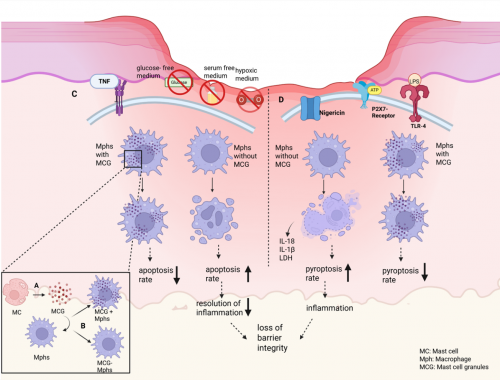
To obtain the Mast cell granules (MCG), Mast cells (MCs) will be stimulated with calcium ionophore in presence of fluorochrome-conjugated avidin to induce degranulation while simultaneously staining the released MCGs (A). Macrophages (Mphs) will be incubated with the isolated avidin-stained MCG, where Mphs will either take up the granules (hereafter MCG+ Mphs) or not uptake macrophages (hereafter MCG- Mphs) (B). Apoptotic and pyroptotic pathways will be analyzed following induction by distinct stress conditions. Apoptosis will be triggered via TNFα + cycloheximide or medium alterations (serum starvation, glucose deficiency and hypoxia) (C), while pyroptosis will be induced by LPS priming followed by nigericin or extracellular ATP (D). Using this approach, we aim to test the hypothesis that MCGs might enhance cellular resilience against stress and death-related pathways, whereas untreated or MCG− Mphs might be more susceptible to cell death.
|

Photos: by UMMD, Melitta Schubert/Sarah Kossmann